On 15 October, the European Commission published guidance on extended producer responsibility (EPR) for small businesses under the Packaging and Packaging Waste Regulation. Two months after the PPWR started to apply on 12 August, it is the clearest signal yet of how the rules will be eased for smaller companies — and a reminder of what is still missing.
Here is where things stand, and what it means for a label converter.
What the new guidance says
According to Packaging Europe's summary, the guidance focuses on keeping EPR proportionate for companies that place small amounts of packaging on the market.
Small producers already have relief. Producers placing less than 10 tonnes of packaging on the market per year benefit from exemptions and flexibilities under the PPWR. The guidance asks Member States and producer responsibility organisations not to load them with disproportionate costs.
Simpler fees and procedures. Among the options suggested: no registration fees, flat and proportionate EPR fees, fast-track procedures, help desks, and fewer documentation and audit requirements for small producers.
Registration still applies. Businesses must still register under the EPR rules of each country where their packaging is likely to become waste.
Authorised representatives may be suspended. The Commission has proposed suspending the requirement for small businesses to appoint an authorised representative in each Member State where they sell. The proposal is with the Council and the Parliament; in the meantime, Member States are asked to enforce the rule in a constructive and pragmatic way.
Harmonised registers are coming. The Commission plans uniform EU rules for registration and reporting, after which Member States would have 18 months to set up or adapt their national registers.
What is still missing: the label itself
The PPWR introduces a harmonised sorting label: a pictogram, the same across the EU, telling consumers which bin a package belongs in. Its design is set by an implementing act that was due on 12 August 2026. It missed that date, and as of late October it is still in preparation: EUROPEN's PPWR tracker lists it as delayed.
The labelling obligation itself applies from 12 August 2028, or 24 months after the implementing act enters into force, whichever is later. For converters, that means time — but not yet certainty about what will have to be printed.
What it means for a label converter
The obligations sit mostly with your customers. Under the PPWR, the producer is the company that places packaged products on the market — usually the brand owner. The new guidance eases the load for the smallest of them. It does not change who receives the questions: which facestock, which adhesive, which inks, what share of recycled content. Those questions arrive at the converter.
A wave of artwork changes is coming, on a date nobody knows yet. Once the sorting label is defined, most packs sold in the EU will need it. As the recent rewrite of recycling claims by Coca-Cola, Nestlé and Danone showed, regulatory wording changes reach the press as batches of reprints, under time pressure.
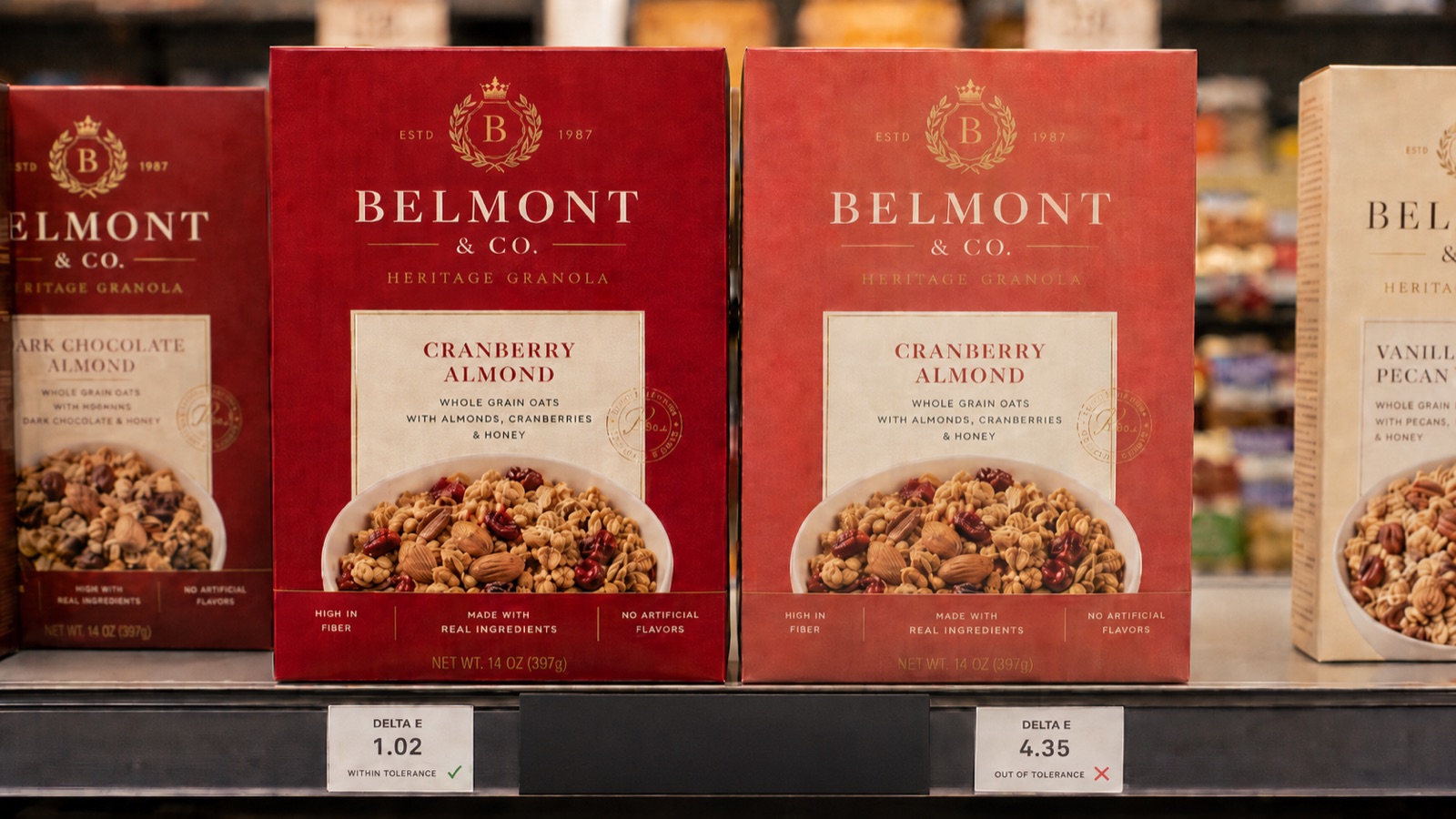
New elements, same brand colors. A new pictogram, new text, sometimes a new layout: the artwork changes, the brand colors must not. Plants that can show, job by job, that color held through the change will have an easier conversation with their customers than plants that rely on the proof.
Keeping track
For the standards and regulatory background, see our primer on ISO 12647-6 and the EU PPWR. For the compliance side itself — recyclability grades, Declarations of Conformity, EPR registrations across 27 Member States — we built PPWR Connect, a compliance dashboard for printers, converters, brands and their suppliers: import your SKUs, and it computes your gaps and your deadlines.
This article is an update, not legal advice: for compliance decisions, refer to the regulation text, the Commission's guidance and qualified advisors. To see how color is kept consistent through a wave of artwork changes, request a demonstration.