Esko's CDI Quartz XPS ecosystem has won the Innovation Award in the supplier category of the FlexoTech Awards 2026. The recognition goes to a simple, ambitious idea: treat platemaking as one controlled process rather than a chain of separate steps — and make the plate come out the same every time.
It is worth a closer look, because it says something about where flexo color consistency is won. And where it still has to be won.
What the Quartz ecosystem does
According to Esko's announcement, the system ties together four parts: the CDI Quartz imager, the Crystal XPS LED exposure unit, Quartz screening software and the Flexo Front End. The imager works at 4,000 ppi and builds microscopic Q-Cell surface structures at 2,000 lpi across solids and screen dots. Imaging parameters are set automatically from the plate type, the substrate, the anilox specification, the press configuration and the ink set.
Esko reports solid ink density gains of up to 0.7, ink savings of up to 20% through lower-volume anilox rolls, and support for water-based inks and substrates with high recycled content. Its own summary of the goal: "highly repeatable plate production and exceptional consistency from job to job."
The direction is clear: more of flexo's variability is being taken out before the plate ever reaches the press.
Why the plate matters so much
For a long time, a large share of flexo variability started before the press: exposure drift, imaging differences, dot shapes that changed from one plate to the next. Two plates for the same job could print measurably differently, and the press crew compensated at makeready, by eye and by experience.
A platemaking process that adapts to the anilox, the press and the ink set — and then repeats itself — removes that variable at the source. Every job starts from the same place. Makereadies get shorter because the press is no longer correcting for the plate.
What still moves once the plate is mounted
A repeatable plate decides where a run starts. It does not decide where the run goes. Once the plate is on the cylinder, the variables that move color are on the press:
Ink. Viscosity drifts over a run as the ink loses solvent and fresh ink is added; with water-based inks, pH drifts too as amine evaporates. Density follows.
Anilox. Cells wear and fill over time; the volume on the spec sheet is not always the volume on the roll.
Impression and mounting. Pressure settings, tape compression and cylinder wear change how the same plate transfers ink.
Speed. Ink transfer and drying change when the press speeds up or slows down for a splice.
Substrate. A new roll, a new lot — and with high recycled content, more lot-to-lot variation in shade and absorbency.
None of these is the plate's fault, and none of them is visible on the plate. They show up in the print, gradually, one revolution at a time.
New plates, new process aims
One practical point for converters adopting new plate technology. If the new plates print with a higher solid density or a different dot gain, the density and dot-gain aims set on the old plates no longer apply. Fingerprint the press again and update those aims. The brand owner's color targets do not move — only the press settings that reach them.
The last mile of color consistency
The quality chain in flexo has two halves. Upstream, repeatable plates and controlled prepress make every job start right. On press, continuous measurement keeps it right — and confirms that the plate's repeatability actually reaches the label.
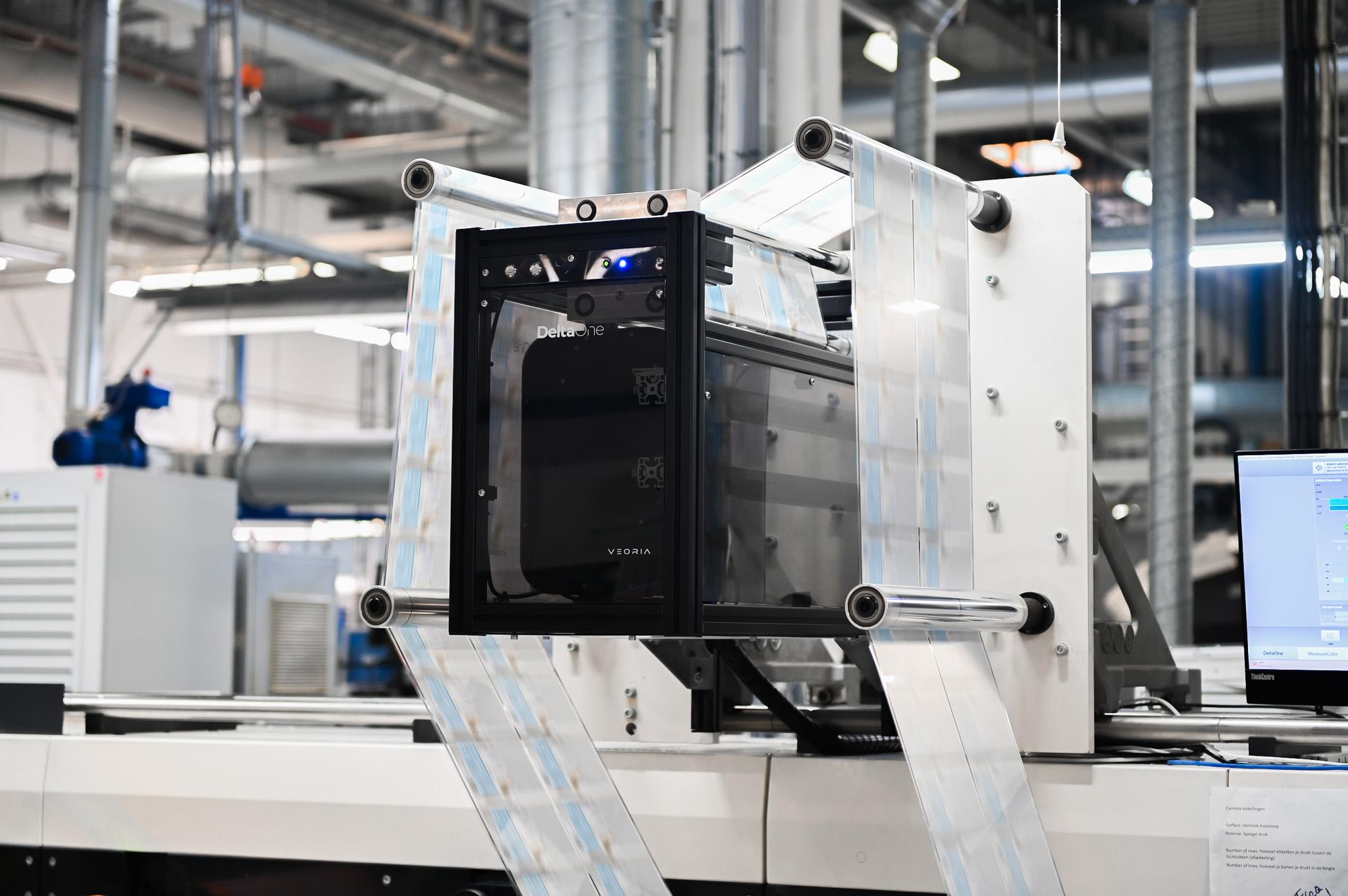
That second half is where DeltaOne works: an inline spectral scanner that reads the colorbar on every revolution, at speeds up to 500 m/min, and shows the operator ΔE, solid density and dot gain for every ink while the web is running. A repeatable plate makes those numbers start in tolerance. Measurement is how you know they stay there.
For how inline measurement relates to the camera inspection systems many plants already run, see print inspection vs inline spectral color measurement. To see both halves together on a running press, request a demonstration.