In September, Consolidated Label described how it has added six Baldwin Guardian PQV inspection systems to its slitter-rewinders since early 2024, with a seventh going onto a 22-inch Nilpeter press. The first phase covered pharmaceutical and nutraceutical work — jobs where a print defect is not a cosmetic problem but a compliance one.
It is a familiar pattern across label plants on both sides of the Atlantic: 100% inspection has become standard equipment, and for good reason. It also raises a question we hear often. If every label is already checked by a camera, what is left for a color measurement system to do?
Quite a lot — because the two systems answer different questions.
What 100% inspection does
An inspection system photographs every label, or every repeat of the web, and compares it with an approved reference: the customer's PDF, or a golden image captured from the OK sheet. Anything that differs beyond a set threshold is flagged — missing print, hickeys, streaks, splices, misregistration, wrong text, a barcode that will not grade.
Its strength is coverage. Every label is looked at, at production speed, and the result is precise about *where*: a roll map that tells the slitter-rewinder exactly which labels to remove. For a pharmaceutical label, where one wrong character can mean a recall, nothing else does that job.
What inline spectral measurement does
A spectral system does something narrower and deeper. It reads defined targets — the colorbar patches — across the visible spectrum, converts each reading to L\*a\*b\* under a defined illuminant and observer, and reports the difference from the brand owner's target as a ΔE. Alongside it: solid density, dot gain, the trend of each ink over the run.
Its strength is that the number means something outside the plant. A ΔE00 of 1.2 against a Lab target is a value a brand owner's specification can be checked against, an auditor can read, and a different instrument in another plant can reproduce. It is the evidence behind the words "in tolerance."
Why a camera is not a color instrument
An inspection camera sees in three channels — red, green and blue — shaped by its own sensor and its own lighting. That is enough to notice that a label looks different from the reference. It is not enough to say by how much, in the terms a color specification uses, because the camera's channels are not tied to the CIE standard observer. Two inks with different spectra can produce the same camera signal and look different in a viewing booth, or the reverse. We covered the physics in more detail in inline spectrophotometer vs RGB camera.
There is a subtler limit too. Inspection checks the run against its reference — and the reference is usually the OK sheet, approved at makeready. If the OK sheet itself was half a ΔE off target, the inspection system will faithfully hold the whole run to the wrong color.
Inspection tells you the run matches the OK sheet. Spectral measurement tells you the OK sheet matches the standard.
Some inspection platforms add a spectral module that reads a few patches alongside the camera. That is a useful combination. When a vendor quotes a ΔE, the question to ask is simply which sensor produced it.
Where each one belongs on the line
Consolidated Label put its inspection downstream, on the slitter-rewinders, which kept flexo throughput untouched while every label was still checked before shipping. That works because most print defects are discrete events: a hickey ruins a handful of labels, the roll map finds them, the rewinder takes them out.
Color drift does not behave that way. When an ink starts to move — viscosity, anilox wear, impression, temperature — every label printed after that moment moves with it. There is nothing to cut out; the roll is either in tolerance or it is not. And the only place drift can be corrected is at the ink unit, while the web is running.
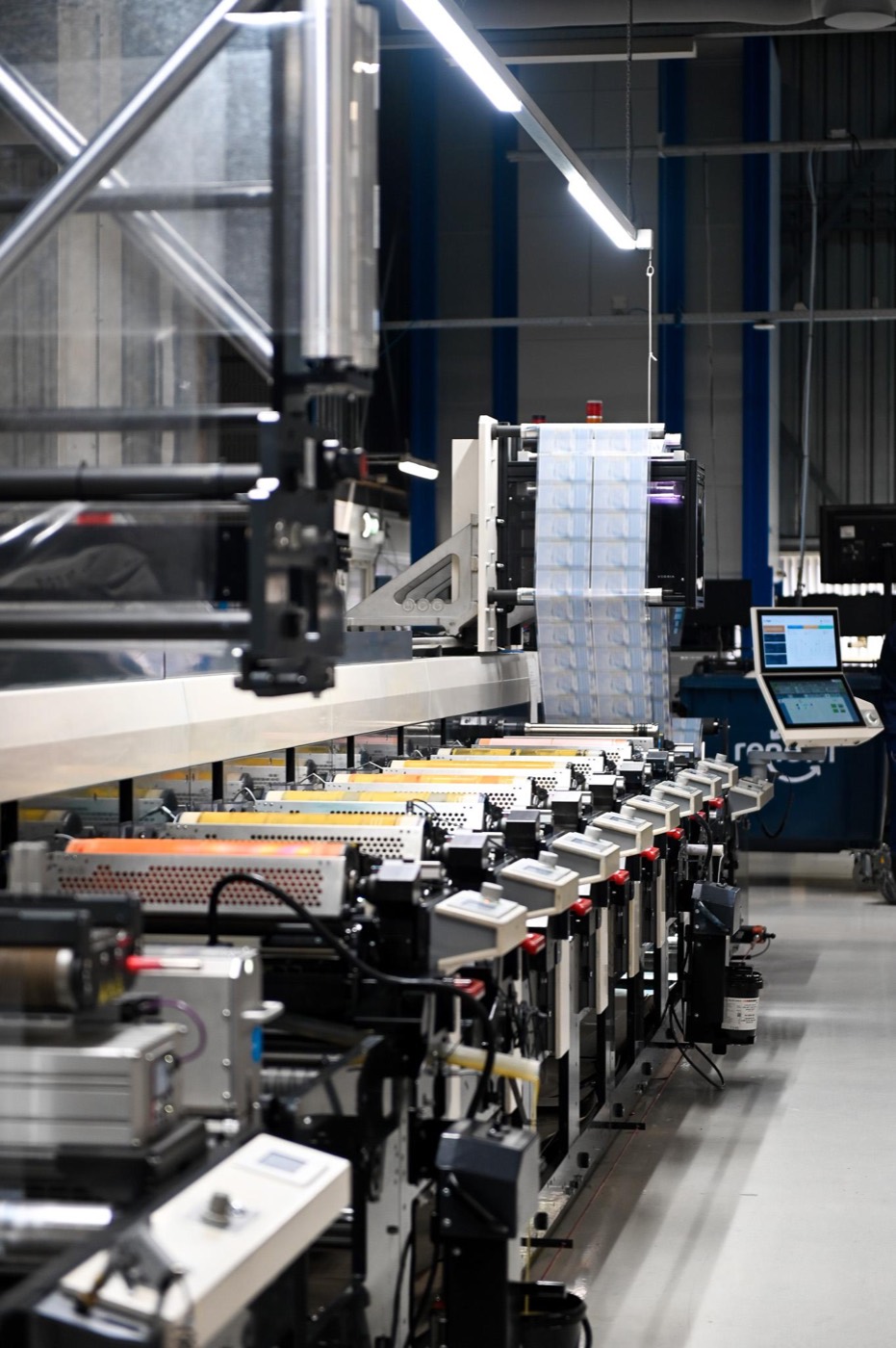
That is why color measurement has to sit on the press. Measured at the rewinder, color becomes a sorting decision. Measured on press, it is a correction — made before the drift becomes a rejected roll.
Two systems, two sets of questions
If you are evaluating inspection, ask about the smallest defect detected at your top speed, how the golden image is created and approved, and how the roll map reaches your rewinder.
If you are evaluating color measurement, ask whether the system is spectral or RGB, which ΔE formula it reports, its repeatability at production speed, and what record you get at the end of a job. Our ten questions for color and inspection vendors go through each one, with what a good answer sounds like.
Both, each in its place
A converter needs inspection for defects and spectral measurement for color conformance. Where to put inspection is a strategic choice, as Consolidated Label's downstream approach shows. Where to put color measurement is not: it belongs where the color is made.
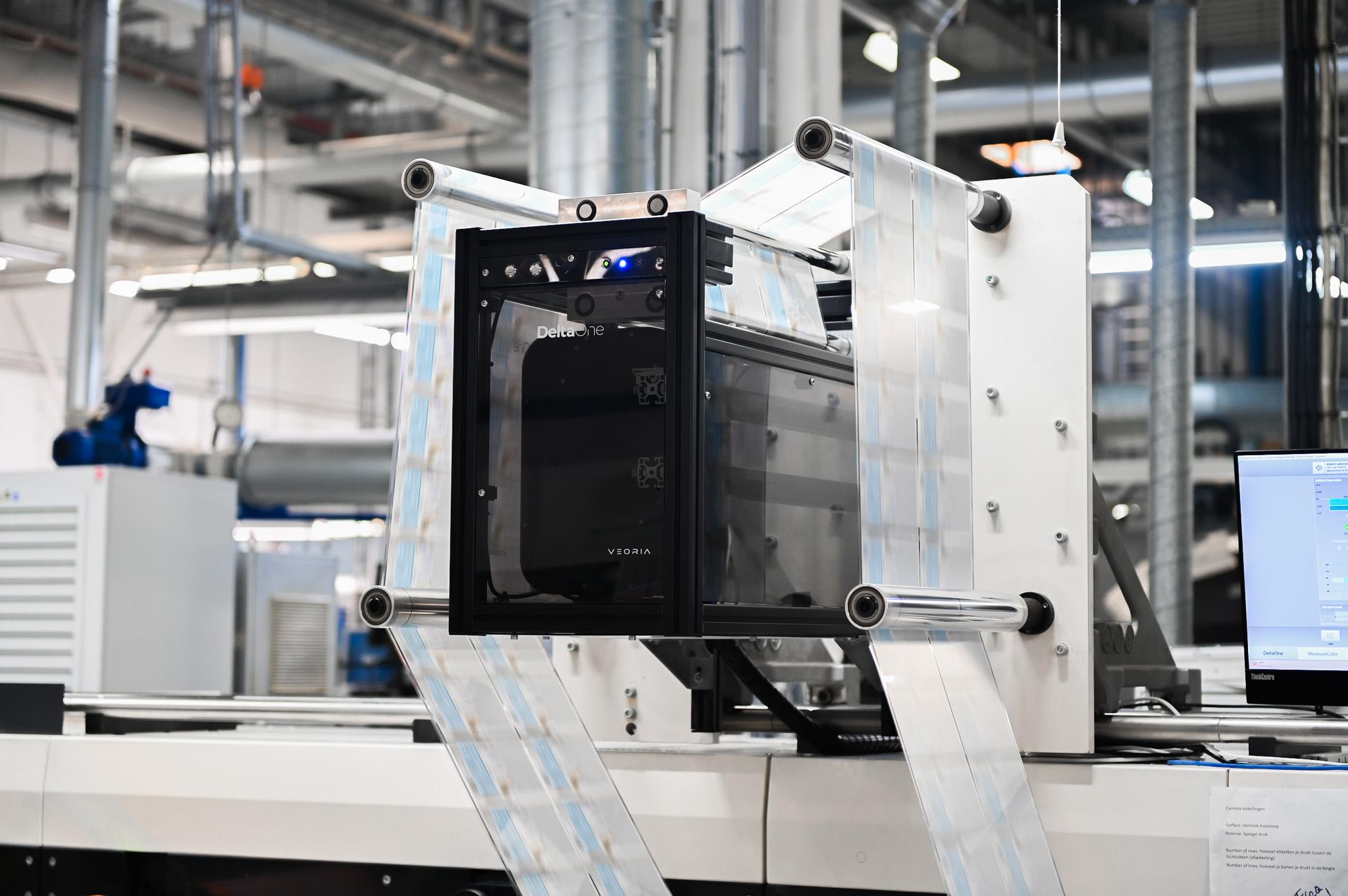
DeltaOne is built for that position — a compact inline spectral scanner that reads colorbars as small as 2 × 2 mm across 36 spectral bands, at speeds up to 500 m/min. It does not look for hickeys. It tells the operator, with a number the brand owner accepts, whether the color is right — and which way to correct it while the web is still running. Request a demonstration to see it on a running press.