AWA's International Sleeve Label Conference & Exhibition returns to Chicago on 17–18 November, with a program covering market trends, design for recycling, films and print innovation — and awards that judge print quality. It is a good moment to look at why sleeves are among the most demanding labels a converter prints for color.
None of the reasons has to do with the skill of the press crew. They come from the format itself.
Why sleeves are hard
Printed on the back, seen through the film. Most sleeves are reverse-printed on clear film: the ink sits on the inside, and the shopper sees the color through the film. Film gloss, thickness and tint all sit between the ink and the eye, and none of them is part of the artwork.
The white decides the color. Behind the colors, an opaque white layer turns clear film into a printable surface. If the white's coverage or thickness varies, every color it backs shifts with it — pastels and light tones first. On a sleeve, a drifting white is a drifting brand color.
The shrink changes what was printed. Artwork is pre-distorted so that it lands correctly once the film shrinks around the container. Where the film shrinks most — shoulders, necks, tapers — the ink layer is compressed and the color can shift. What the shopper sees on the container is not exactly what came off the press.
What is behind the film changes the reading. A measurement on clear film depends on what sits behind it: a white tile, a black one, the edge of a desk. On the shelf, it is the container and whatever it holds. Two readings of the same print with two different backings are two different numbers.
Why sampling falls short on sleeves
Sleeve jobs are often long runs on thin, fast-moving film. Checking color offline means pulling a sample, choosing a backing, measuring through the film — a handful of readings per roll. Meanwhile, the white can drift between two samples without anyone seeing it on the flat web, because the change only becomes obvious once the colors are judged against the approved container.
What to control
Control the flat print, consistently. The shrink tunnel adds its own variation, which is all the more reason to keep the press side stable. Define color targets on the printed film, correlated once with the approved shrunk container, and hold the film to those targets.
Treat the white as a color. Measure it, set a target for it, and watch it through the run. Many color complaints on sleeves start as a white problem.
Measure the same way every time. Same side of the film, same backing, same instrument settings — at the press, at the quality desk and at the customer. Agree on them in writing with the brand owner.
Keep the record per job. When a sleeve looks different on shelf, the first question is whether the print changed or the shrink did. A measurement log from the press answers half of it immediately.
Inline measurement on sleeves
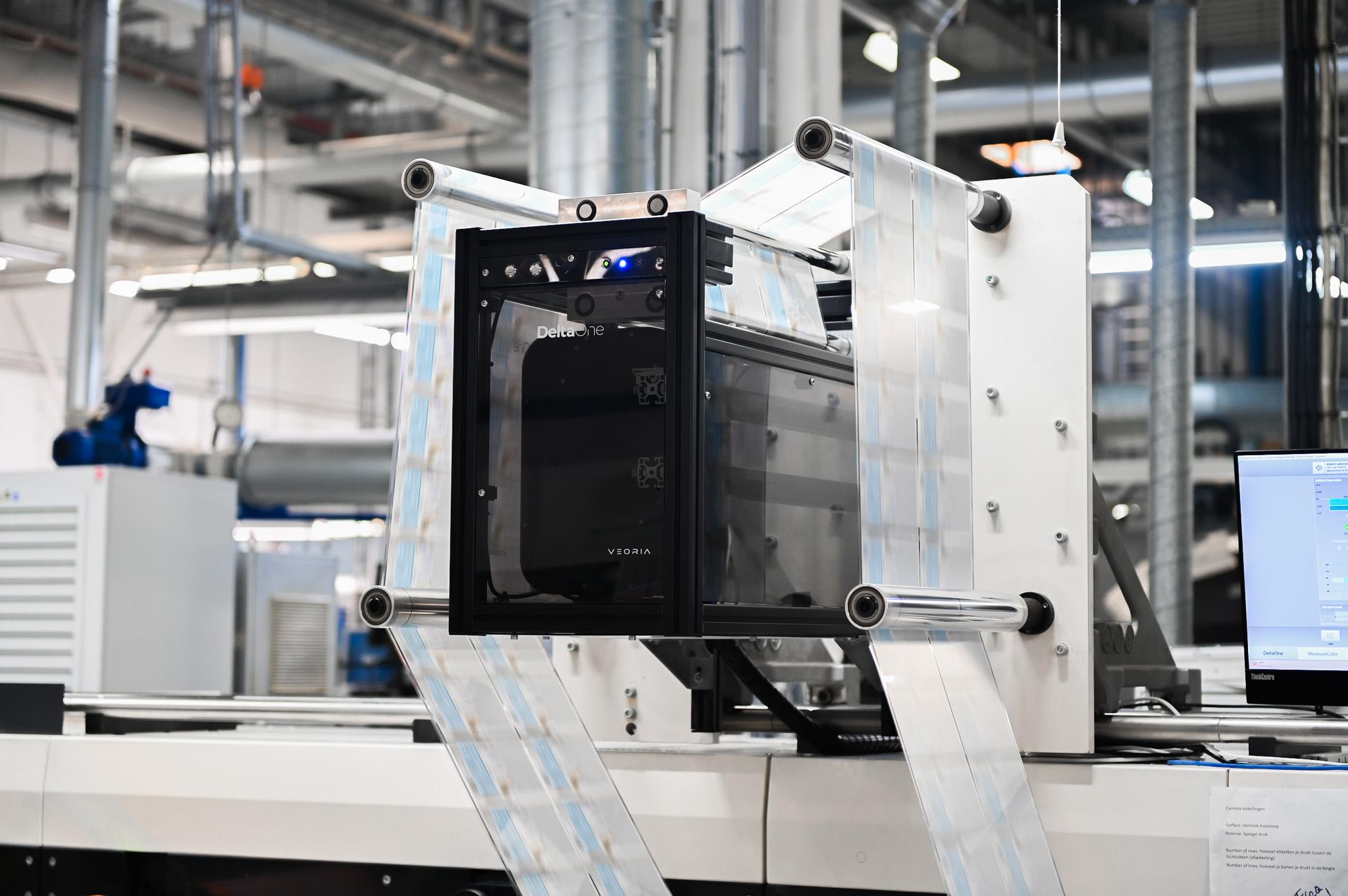
The value of continuous measurement on sleeves is the same as on any label — drift shows up when it starts, not at the next sample. DeltaOne measures sleeve jobs inline, on the press, as long as the colors are backed by a white underprint — the same white that makes them opaque on the container. In practice, that means laying out the colorbar over the white.
For how inline measurement relates to camera inspection on the same line, see print inspection vs inline spectral color measurement.
To talk through your sleeve jobs with us, request a demonstration.